18 Oct 2026
Revealing the Human Stories Interwoven with Production Statistics and Policy Timelines in Byproduct Industries
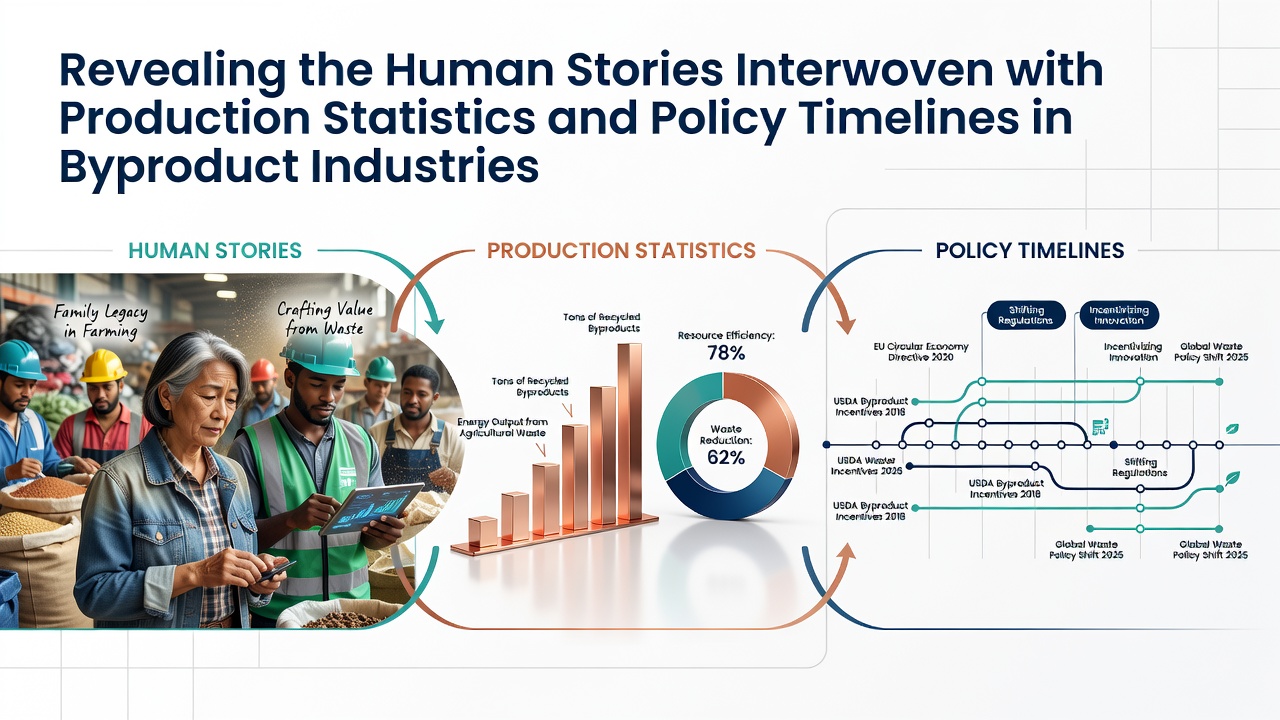
Byproduct industries span mining, agriculture, and chemical manufacturing where materials once considered waste now generate significant economic value through recovery and reuse. Production statistics reveal steady growth in sectors that transform slag, spent grains, and chemical residues into construction aggregates, animal feed, and industrial chemicals. Data from government agencies shows that byproduct recovery rates in several regions have climbed from under 40 percent in the early 2000s to more than 65 percent by 2025, driven by both regulatory pressure and market demand for secondary raw materials.
Production Statistics and Shifting Output Patterns
Figures compiled by the U.S. Geological Survey indicate that steel slag production reached 11.5 million metric tons in 2024, with approximately 85 percent directed toward road base and cement applications. Similar patterns appear in the European Union where Eurostat reports document a 12 percent rise in food processing byproduct utilization between 2020 and 2025, particularly in the conversion of whey and fruit pomace into nutritional supplements. Observers note that these volumes correlate closely with employment levels in rural processing plants, where communities historically dependent on primary extraction have pivoted toward byproduct handling facilities that require different skill sets and safety protocols.
Canadian government data further illustrates how potash mining byproducts such as salt tailings have moved from storage ponds into de-icing products and agricultural amendments. Production volumes for these secondary streams exceeded 2.8 million tonnes last year, supporting jobs in Saskatchewan and New Brunswick that did not exist at scale two decades ago. Researchers tracking labor markets point out that workers transitioning from primary extraction roles often receive targeted training programs funded through industry levies, creating measurable shifts in local wage structures and retention rates.
Policy Timelines That Reshape Industry Practices
Regulatory frameworks have evolved through successive amendments that tie environmental compliance directly to byproduct management. The European Union’s Circular Economy Action Plan, updated in stages since 2015, set binding targets for 2030 that require member states to achieve 70 percent recovery of construction and demolition byproducts. In October 2026, additional reporting requirements under the revised Industrial Emissions Directive will take effect, mandating real-time tracking of residue streams from chemical plants across the bloc. These measures build on earlier directives that first introduced extended producer responsibility for byproduct streams in 2018.
Australia’s National Waste Policy, refreshed in 2020, established timelines for reducing landfill disposal of mining and agricultural residues, with interim benchmarks scheduled for review in late 2026. State-level implementation in Western Australia and Queensland has produced measurable increases in byproduct exports, particularly gypsum and bagasse derivatives. Industry associations report that these policy milestones have prompted capital investment in processing equipment, altering both the physical layout of facilities and the daily routines of operators who now monitor quality metrics previously handled by separate compliance teams.

Human Stories Tied to Data and Deadlines
Communities located near large-scale byproduct operations often experience direct connections between production volumes and local infrastructure. One study from the University of Alberta documented how increased recovery of oil sands tailings in northern Alberta coincided with expanded vocational programs at regional colleges, enabling residents to move from seasonal work into year-round roles monitoring centrifuge systems and water treatment units. Employment records show that these positions carry different risk profiles than traditional extraction jobs, prompting updates to safety training that emphasize chemical exposure limits rather than heavy machinery operation.
Policy deadlines also influence family and community decisions. In regions affected by the EU timelines, plant managers have described how advance notice of the 2026 reporting rules allowed time to hire data specialists who work alongside long-term operators, blending institutional knowledge of material flows with new digital tracking systems. Local governments in several member states have used the same timelines to coordinate housing and transport planning, recognizing that byproduct facilities tend to cluster in areas already supporting related logistics networks.
Trade publications highlight cases where byproduct valorization has altered town economies that once relied solely on primary commodity cycles. In parts of South Africa, for instance, ferrochrome slag recovery operations established since 2019 have generated ancillary businesses in aggregate crushing and asphalt production, creating employment pathways for younger workers who might otherwise have left the region. Government statistics link these developments to measurable changes in household income stability, even as they require ongoing coordination between mining companies and municipal authorities to manage dust and transport impacts.
Conclusion
Production statistics, policy timelines, and the lived experiences of workers and communities remain tightly connected within byproduct industries. Government datasets from multiple continents document rising recovery volumes, while regulatory schedules such as those taking effect in October 2026 continue to shape operational practices and training requirements. These elements together illustrate how material flows that begin as industrial residues translate into employment patterns, skill development, and infrastructure planning that extend well beyond the factory gate.